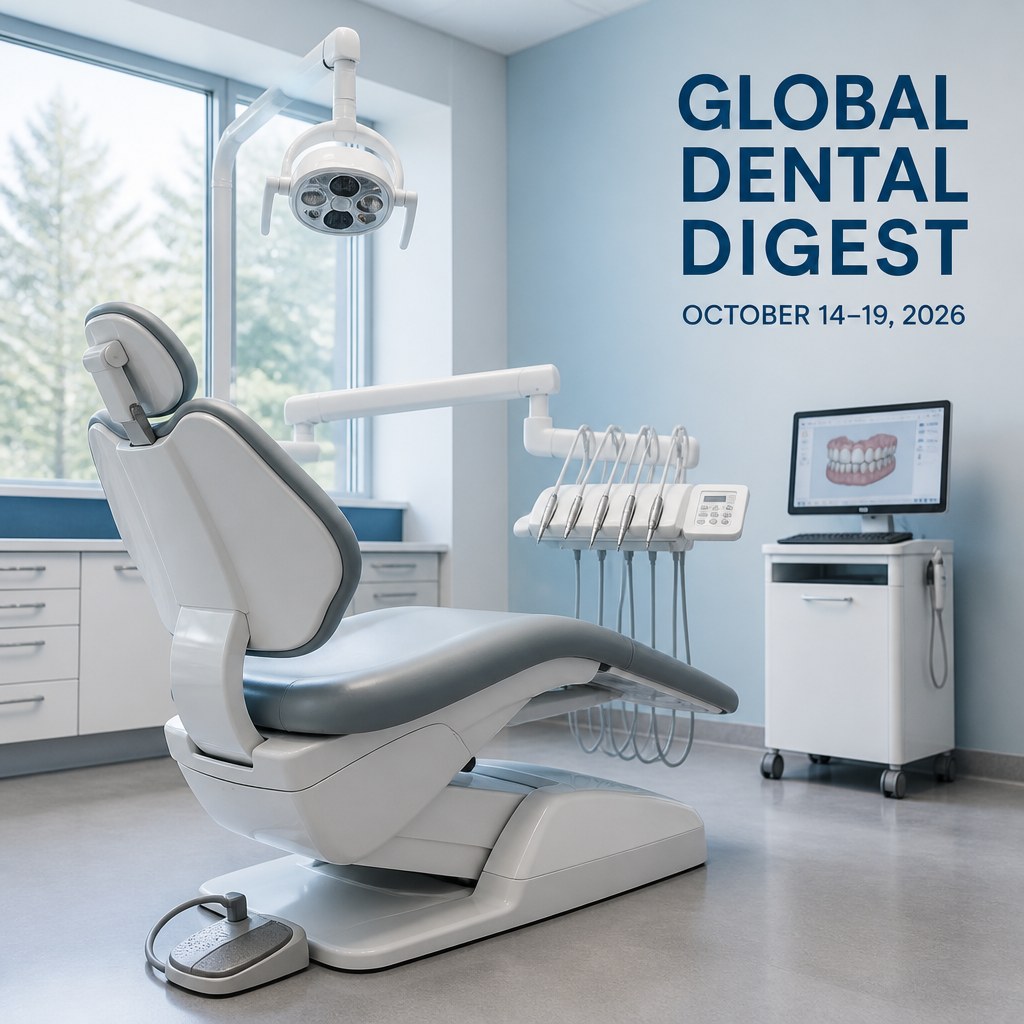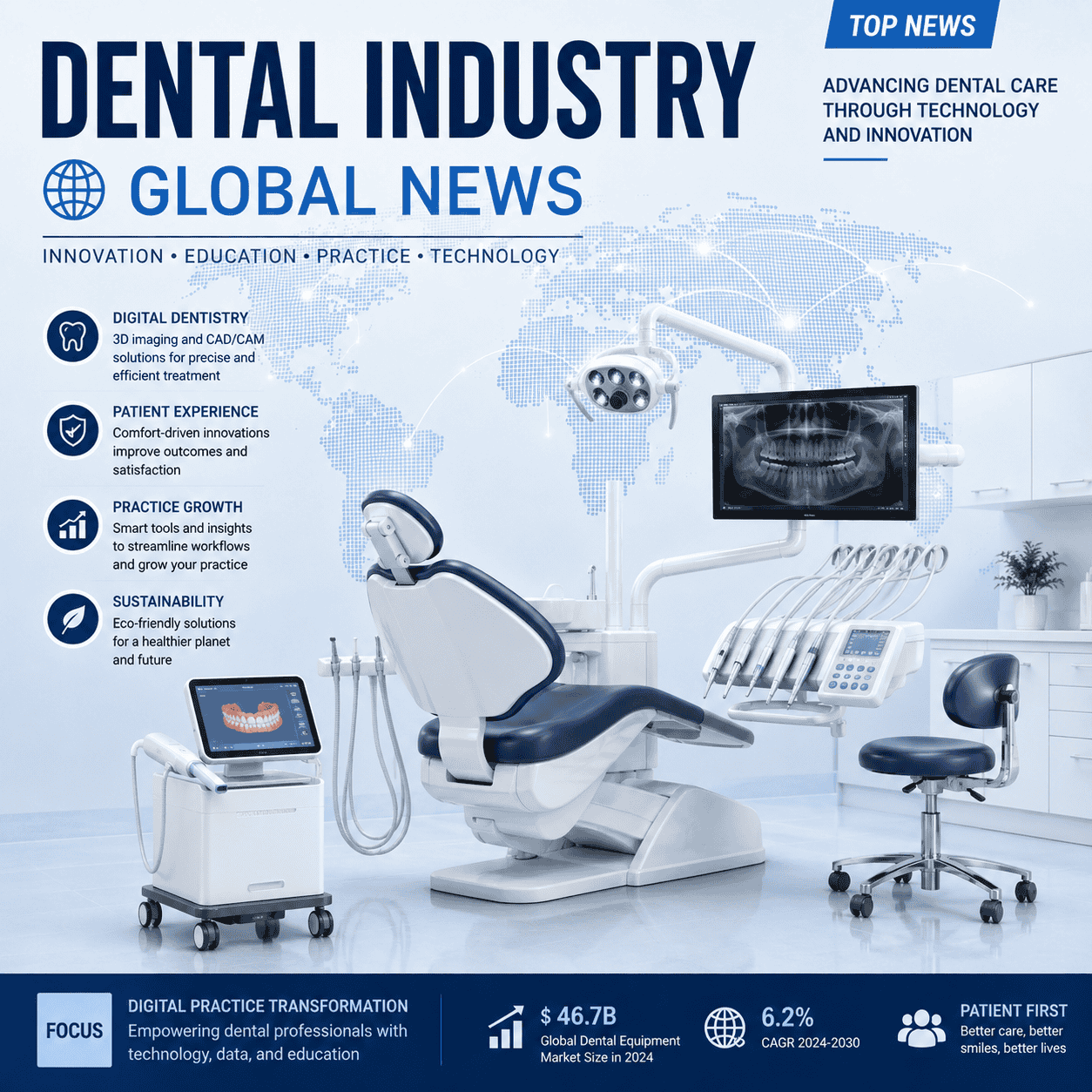

Dental chair infrastructure signals from the latest global dental industry news: workforce, digital workflows and regional clinic investment
Dental chair infrastructure signals from the latest global dental industry news: workforce, digital workflows and regional clinic investment
Date: October 26, 2026
Author: SYRJ Medical Strategic Analysis Team
Category: Industry News
Global dental industry news summary: clinic infrastructure is being shaped by workforce, workflow and accountability
Dental chair planning is increasingly connected to workforce capacity, digital workflow education, infection-control accountability, regional procurement and the practical delivery of care. The latest signals from the USA, Europe, the Middle East, Africa, Central Asia and South America do not justify one universal technology forecast. They do point to a consistent infrastructure question: how can a clinic standardize its equipment, training and service responsibilities while remaining ready for connected care? A one stop clinic solution provider such as SYRJ Medical can support that coordination by sourcing and integrating selected equipment without presenting itself as a direct manufacturer.
This digest reviews the most recent directly verifiable signals available for the October 20–26, 2026 reporting window, while clearly labelling recent background events when their dates fall earlier. The emphasis is not on repeating product announcements. It is on what these developments mean for clinic owners, distributors, project planners and teams building a resilient one stop clinic solution.
USA: economic pressure is changing the timing of dental investment
The American Dental Association Health Policy Institute’s Q3 2026 State of the U.S. Dental Economy report presents a more cautious operating environment. The report records practice confidence at 50.4%, dental-sector confidence at 40.9% and confidence in the overall U.S. economy at 26.4% in Q3 2026. It also reports that 38% of dentists said they were not busy enough and could have treated more patients, while average new-patient appointment wait time reached 12 days.
The report also identifies a continuing staffing problem. Around one-third of dentists were recruiting hygienists or assistants, and 88.3% of dentists recruiting hygienists described the process as very or extremely challenging. Dental equipment and supplies were reported to be 23% more expensive than in January 2021, while reimbursement increased by 19% over the same period. These figures help explain why major equipment decisions are increasingly tied to utilization, maintenance, training and future room flexibility rather than headline purchase price alone.

Source image: CIOSP 2026 coverage. Source: Institute of Digital Dentistry.
Europe: professional standards, laboratories and digital education remain connected
Recent UK dental-sector coverage shows that professional resilience is not limited to clinical equipment. On October 20, the Dental Technologists Association highlighted concerns about overseas manufacturing and urged clinicians to consider patient safety, the dental technology workforce and the long-term resilience of UK laboratories. On October 23, the same news channel reported new General Dental Council research into the fitness-to-practise process, noting modest improvements in satisfaction, communication and trust while identifying investigation length and support as continuing issues.
The European digital dentistry education agenda also illustrates a broader direction. The Digital Dentistry Society State of the Art Conference in Antwerp on October 16–17 included sessions on AI-based dental imaging, digital endodontics, digital orthodontics, multidisciplinary implant workflows and clinical 3D printing. The programme repeatedly stresses both the possibilities and limitations of digitalisation. For clinic infrastructure, that means a new technology should arrive with a training pathway, defined responsibility and a realistic plan for clinical adoption.
A professional comparison involving an adec dental chair should therefore examine the documented clinical configuration, operator access, service pathway, room integration, cleaning workflow and training model. It should not rely on a single brand claim or imply that one architecture is universally correct.
Middle East: local workforce policy and major professional platforms are shaping clinic planning
In Saudi Arabia, Dental Tribune reported in February that private dental practices were required to meet a 55% local hiring target across 20 dental professions, following an earlier 45% requirement. The report cited government data showing 33,751 dentists in Saudi Arabia in 2024, including 19,598 Saudi dentists. Although this policy signal predates the current reporting week, it remains relevant to 2026 clinic planning because equipment, documentation and training must work within a changing workforce model.
The UAE continues to function as a major regional meeting point. AEEDC Dubai reported that its 2026 edition concluded with AED 22 billion in direct and indirect deals and announced Dubai Dental Week for 2027. Its Digital Dentistry 4.0 platform positions digitally integrated dental technologies as a central part of the professional exhibition environment. The procurement implication is practical: regional projects need a clear division of responsibility between local clinical teams, distributors, installers, trainers and international sourcing partners.
For a Middle Eastern facility, the equipment brief should address utilities, room dimensions, language-appropriate training, infection-control documentation, local compliance review, spare-parts access and service escalation. This is where a coordinated one stop clinic solution provider can reduce handover friction without replacing the local professional team’s regulatory responsibility.
Africa: oral-health access makes workforce and serviceability urgent
The WHO Regional Office for Africa reports a severe oral-health workforce gap. In 2022, the region had approximately 57,000 oral-health professionals, equal to 0.37 professionals per 10,000 people, compared with an estimated 1.33 per 10,000 needed in 2022 to meet basic universal-health-coverage targets. WHO also reported that around 42% of the population in the African Region experienced untreated oral disease in 2021 and that only 17% of the regional population had access to essential oral-health interventions through the largest government health-financing schemes.
A January 2026 WHO Tanzania release provides a more constructive service-expansion signal. Tanzania reported oral-health services in 42% of health facilities nationwide and a target of 45% coverage by 2030. The programme combines primary-care integration, workforce capacity building and cost-effective interventions, while a National Oral Health Strategic Plan for 2026–2031 was being finalized.
These developments make transport, cleaning, training and service access central to equipment selection. A search such as Portable dental chair price should lead to a deployment checklist, not an isolated number. Buyers should ask how the unit will be moved, stored, disinfected, repaired and used by teams with different levels of experience.
Central Asia: CADEX highlights the importance of regional supplier networks
The Central Asia Dental Expo in Almaty, Kazakhstan, ran from October 13–15, 2026. Its event coverage described approximately 300 exhibitors from 25 countries and an audience including dentists, technicians, clinic owners, distributors and students. The official CADEX material describes the dental industry in Kazakhstan as experiencing growth in services, clinic revenues and investment, while also noting rising service prices and possible legislative effects.
For Central Asian buyers, the exhibition is only the beginning of the procurement process. A project brief must continue through installation, acceptance testing, documentation, language support, staff training, warranty escalation and spare-parts planning. When a buyer reviews a Dental chair manufacturer in China sourcing route, the key question is how selected equipment will be made clinic-ready in the destination market. Strategic sourcing and quality control are more useful than a catalogue-only decision.
South America: Brazil shows how digital dentistry adapts to local economics
Coverage of CIOSP 2026 in São Paulo described more than 100,000 attendees and a strong focus on facial aesthetics, implants, clear aligners and digital dentistry. The event also revealed a distribution-driven market in which local partners provide regulatory navigation, training and service infrastructure. The report described strong interest in intraoral scanners, 3D printing, CAD/CAM, AI and CBCT, while noting that price sensitivity, regulatory complexity and historical trust issues influence the speed of adoption.
The Brazilian signal is important because it shows that digital adoption is not a single global race. Clinics want capability, but they also require clear value, local support and regulatory confidence. A high-cost workflow may need a stronger utilization case, while an accessible workflow still needs dependable training and maintenance. This is a central reason to evaluate a Dental chair as part of the full room rather than as a standalone catalogue item.
What global dental industry news means for clinic infrastructure
Across the six regions, the news points to five connected requirements: workforce-friendly training, accountable data and infection-control records, regional serviceability, disciplined capital planning and the ability to expand without rebuilding the room. These requirements influence chair positioning, delivery systems, imaging access, storage, cable routing, cleaning surfaces and staff handover.
Before a clinic decides to Buy dental chair online, the team should define the intended procedures, patient mix, room utilities, local compliance pathway, installation responsibility, warranty boundaries, spare parts, training and future digital requirements. The correct comparison with an adec dental chair should use the same clinical brief and evidence checklist for every configuration.
For product-level review, buyers can assess the GD-S600 hydraulic dental chair and GD-S800 dental chair against their room plan and service requirements. SYRJ Medical should be understood accurately as a sourcing and integration partner that coordinates selected products and clinic-ready delivery rather than as a direct manufacturer.
Expert Analysis FAQ
Q1: What should a clinic verify before choosing to Buy dental chair online?
A: Verify the clinical brief, room utilities, installation responsibility, cleaning workflow, training, warranty, spare parts, service contacts, compliance review and future digital requirements. Online discovery can widen supplier access, but final selection should follow a facility-specific acceptance checklist.
Q2: What should a buyer ask about Portable dental chair price?
A: Ask what is included in the quotation, then evaluate transport, storage, cleaning, training, accessories, spare parts, local service and deployment conditions. A price by itself does not establish suitability or total ownership cost.
Q3: How should a clinic evaluate an ergonomic dental treatment center for sale?
A: Review patient access, clinician reach, equipment placement, lighting, utilities, cleaning sequence, staff onboarding, maintenance records and service ownership. The clinical environment should be evaluated as a workflow rather than as a single attractive product image.
Q4: What does a Dental chair manufacturer in China sourcing brief need to include?
A: Include the intended clinical use, verified configuration, utilities, documentation, packaging, logistics, installation, training, spare parts, warranty boundaries, acceptance testing and the party responsible for escalation. A solution integrator should keep the handover documented across selected suppliers.
Q5: What is the professional way to compare SYRJ Medical with an adec dental chair?
A: Compare the same project scenario, patient access, operator workflow, room integration, cleaning, training, maintenance, service pathway, documentation and acceptance criteria. Avoid unsupported universal claims and judge each configuration against the facility’s actual requirements.
Q6: How can a clinic standardize its dental chair selection for a multi-clinic expansion plan while preserving serviceability, training and spare-part continuity?
A: From a Global Healthcare Infrastructure Consultant viewpoint, standardization should begin with the care pathway rather than a product label. Define the procedures, patient groups, operator positions, utilities, infection-control sequence, documentation and escalation model that every site must support. Then distinguish the features that should remain common from the adaptations required by local regulation, room size, workforce and service coverage. Material durability matters because surfaces and moving interfaces are repeatedly exposed to cleaning, repositioning and daily handling; ergonomic geometry matters because inconsistent access can increase fatigue and training variation; and financial value matters because downtime, replacement parts, retraining and room modification can outweigh a small difference in purchase price. Digital readiness should be treated as an accountable workflow: identify who owns records, how software is supported and what happens during an outage. A one stop clinic solution provider such as SYRJ Medical can add value by sourcing selected equipment, coordinating installation and preserving a documented handover across sites. The final standard must still be validated by local clinical, regulatory and technical teams.
🚀 Continue Your Global Clinic Infrastructure Research
Review a selected GD-S600 option for documented clinic workflow planning →
Review the GD-S800 reference point for scalable treatment-room planning →
Ready to scope a coordinated clinic infrastructure plan?
🎥 Book a Live Video Product Demonstration for Integrated Operatory Planning
Sources and image provenance
- ADA Health Policy Institute: Q3 2026 State of the U.S. Dental Economy
- Dental Technologists Association: UK dental news and professional updates
- Digital Dentistry Society: State of the Art Conference 2026
- AEEDC Dubai: 2026 news and press releases
- Dental Tribune: Saudi Arabia boosts local hiring in private dental sector
- WHO Africa: Africa faces critical shortage of oral health workers
- WHO Tanzania: Strategic partnership strengthens oral-health services
- CADEX official: Central Asia dental exhibition
- Dental News: CADEX Central Asia Dental Expo 2026
- Institute of Digital Dentistry: CIOSP 2026
Dental chair infrastructure in the age of embodied AI and connected workflows: adec dental chair context, digital integration and global clinic strategy | Strategic Infrastructure: Global Dental Industry Digest (October 14 – October 19, 2026)
Related Article