
Selecting Oral Surgery Chairs: Key Dental Operatory Chair Requirements for Minimally Invasive Implant Surgery
Selecting Oral Surgery Chairs: Key Dental Operatory Chair Requirements for Minimally Invasive Implant Surgery
Author: SYRJ Medical Strategic Analysis Team
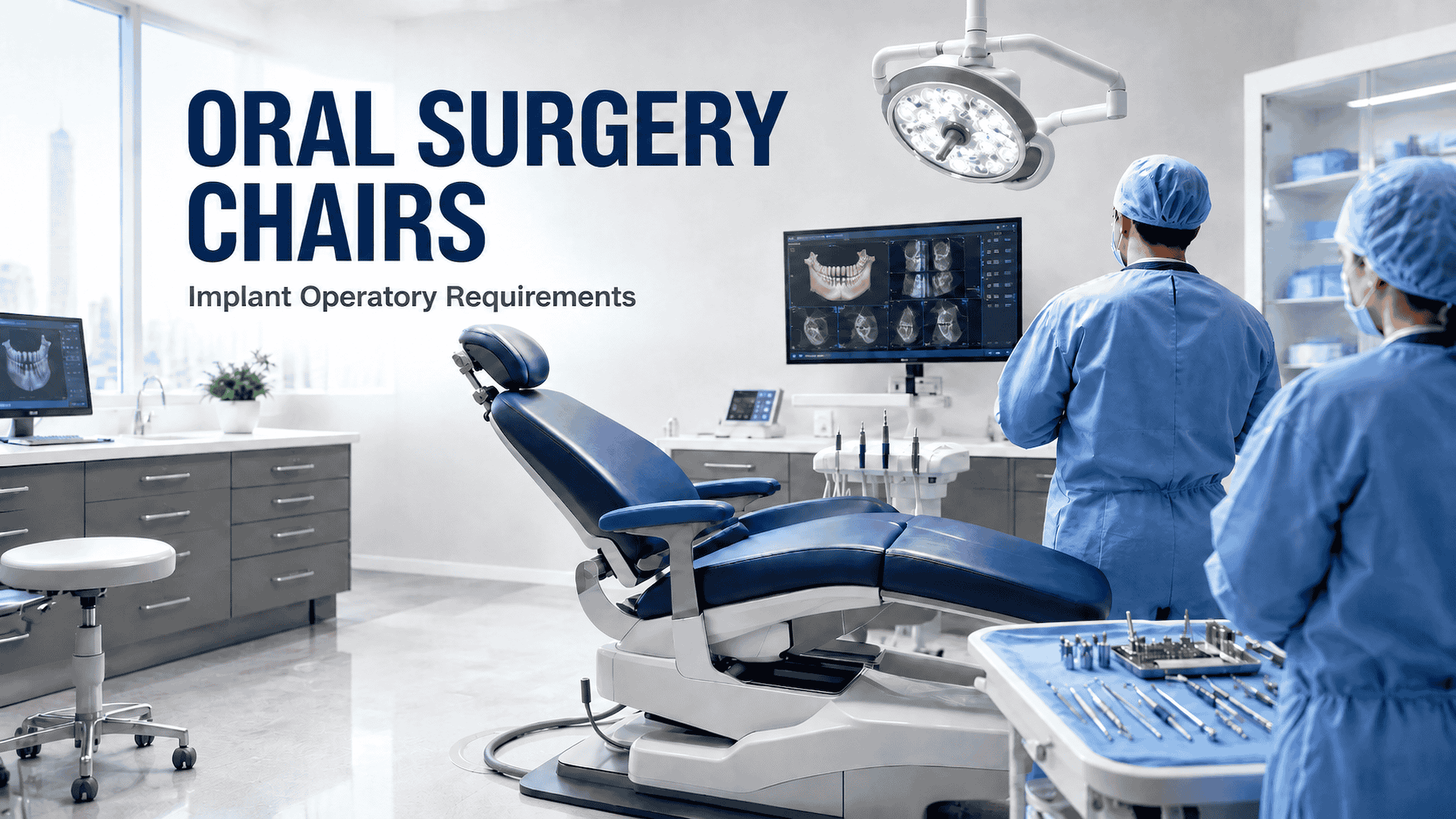
Visual Summary: Dental chair requirements for minimally invasive implant surgery
A clinically useful implant operatory connects CBCT planning, anaesthesia, osteotomy, implant placement, restoration, recovery and review with stable patient support, controlled illumination, precise motor output, efficient aspiration and a clean digital workflow.
Why the chair is a surgical platform, not just a seat
Minimally invasive implant surgery is often described through the implant, drill, guide or CBCT plan. Yet the dental chair is the physical platform that holds the patient, clinician and assistant in the same working geometry. It determines whether the patient can be positioned reproducibly, whether the clinician can maintain a stable operating posture, whether the surgical light can follow the field and whether the delivery system remains accessible.
This is why implant dental units and implant surgery dental units should be evaluated as integrated clinical infrastructure. The chair must support the full sequence without forcing the team to improvise around weak positioning, vibration, difficult access or poorly arranged instruments. The practical question is which configuration makes the intended implant protocol repeatable, serviceable and comfortable.
A comparison with an adec dental chair should remain professional and evidence-led: compare patient access, base stability, delivery architecture, lighting, motor integration, cleaning workflow, service support, future expandability and the clinic’s intended case mix.
Stage 1: consultation, medical review and CBCT planning
The complete dental implant procedure step by step begins with examination, medical review, periodontal assessment and dental CBCT imaging system. Imaging helps evaluate bone, roots, nerve pathways and sinus anatomy before the clinician confirms the plan.
| Planning checkpoint | Clinical question | Operatory implication |
|---|---|---|
| Bone volume and density | Is the site suitable for the planned protocol? | Clear access, stable positioning and imaging visibility. |
| Nerve and sinus anatomy | Is additional caution or preparation required? | Monitor placement and assistant access without obstruction. |
| Occlusion and restoration | Immediate, staged or delayed loading? | Repeatable treatment and review positions. |
Stage 2: preparation, extraction, grafting and sinus lift
Not every patient proceeds directly to implant placement. Extraction, bone grafting and sinus lift procedures may be needed when bone volume is insufficient or infection must be managed first. These stages can lengthen the biological timeline even when active chair time is short.
For procurement, bone grafting and sinus lift equipment should be assessed as part of the same operatory ecosystem. The chair needs different clinician positions, a predictable sterile field, suction and irrigation, lighting that follows the access angle and sufficient room for graft materials and instruments.
Stage 3: anaesthesia, patient positioning and sterile-field preparation
Implant placement is commonly performed with local anaesthesia; sedation depends on the patient, procedure and local practice. The team prepares sterile instruments, irrigation, aspiration, implant components and any grafting materials.
This is where ergonomic dental chair design becomes a surgical requirement. Backrest, head support, arm position, leg support and entry angle influence access, while the assistant needs reach to suction, irrigation, instruments and controls without crossing the sterile field.
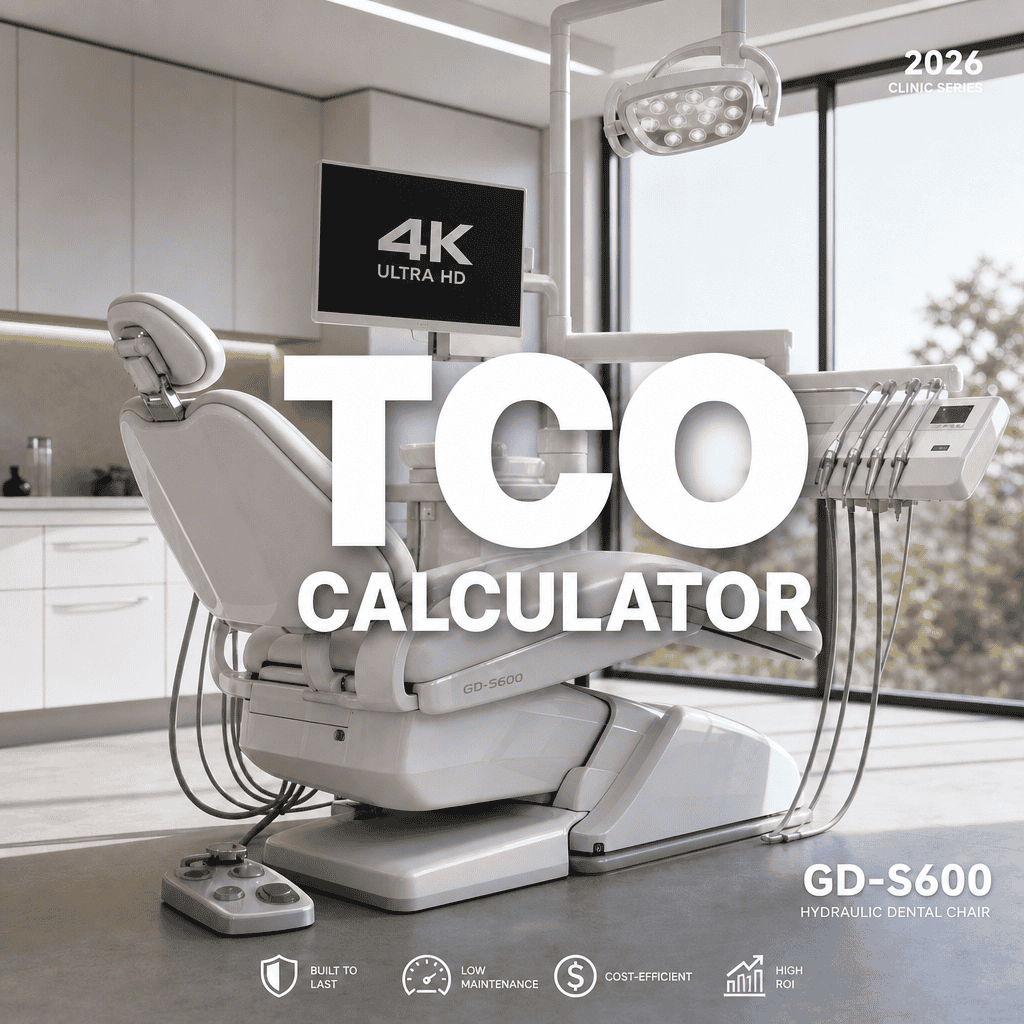
GD-S600 hydraulic dental chair when the clinic prioritises smooth, stable elevation and controlled positioning under load. Hydraulic systems are not automatically superior for every case; selection should consider service support, control architecture, noise, movement range and local maintenance capability.
Stage 4: flapless surgical protocol and site preparation
A flapless surgical protocol may be appropriate in selected cases when anatomy, imaging, soft tissue condition and the surgical plan support limited tissue disruption. These protocols are not interchangeable; the treating clinician determines the correct technique.
The chair and unit must provide controlled access. The patient’s head must remain stable, the light must provide a shadow-reduced field, and the clinician must operate the motor and irrigation without searching for controls. A foot control can reduce unnecessary hand movements.
A stable base matters because the chair becomes the reference frame for the clinician’s hands and the patient’s jaw. Hydraulic-versus-electric evaluation should focus on movement behaviour, support under load, repeatability and serviceability.
Stage 5: integrated electric implant motor and osteotomy control
The central equipment requirement is an integrated electric implant motor with programmable speed, irrigation and hands-free operation. For surgical power and hand-instrument compatibility verification, review dental handpieces. Reliable integration keeps motor control within the sterile workflow and maintains compatibility with the clinic’s instruments.
Precise torque control matters because implant placement is not simply drilling. Settings follow the implant system, bone condition, osteotomy plan and loading strategy. Buyers should request speed, torque, irrigation, foot control, handpiece, cleaning and service documentation.
| Motor and delivery requirement | Why it matters in implant surgery | What to verify before purchase |
|---|---|---|
| Integrated electric implant motor | Keeps motor control within the planned workflow. | Motor, handpiece, irrigation and service compatibility. |
| Precise torque control | Supports controlled insertion according to protocol. | Display clarity, programmable settings and calibration. |
| Foot or hands-free control | Reduces unnecessary hand movement. | Control placement, cleaning and failure recovery. |
| Irrigation and aspiration | Helps manage the working field and instrument workflow. | Flow control, tubing, filters, disinfection and consumables. |
Stage 6: LED surgical lighting and assistant workflow
LED surgical lighting and a dental operating light should be assessed for shadow reduction, intensity adjustment, colour temperature, positioning range and control accessibility. Illumination is a core implant-unit requirement because visibility affects the clinician’s ability to distinguish tissue, instruments and the osteotomy site.
The light should move with the workflow without forcing the clinician to leave the operating posture. Its arm must hold position yet remain easy to adjust. The assistant’s side should allow suction and instrument transfer without blocking the light or patient access.
Stage 7: implant insertion, primary stability assessment and loading decision
After the osteotomy is prepared, the implant is inserted according to the planned protocol. Primary stability assessment is a key decision point. Insertion characteristics, bone quality, implant design, position and expected functional loading influence immediate restoration, temporary support or delayed loading.
Immediate loading values are not universal specifications for every implant system or patient. The safe equipment principle is to provide stable access and a repeatable posture while the clinician evaluates the case; the chair cannot determine biological suitability or replace professional assessment.
Stable hydraulic positioning may support a calmer transition between surgical and review positions, but the benefit must be confirmed through demonstration and service documentation.
Stage 8: suturing, temporary restoration and immediate aftercare
Depending on the technique, the surgical site may be closed with sutures or managed through a minimally invasive approach. A temporary restoration or overdenture attachment may be considered when clinical criteria support it. The patient receives instructions about bleeding, swelling, food, hygiene, medication, smoking, alcohol, activity and warning signs.
The operatory should support this handover: return the chair to a comfortable position, move the light away from the patient’s eyes, review instructions and disinfect the field. For temporary-material procurement reference, review UV curing machine without assuming performance specifications. Discharge is part of the implant workflow.
Stage 9: osseointegration, abutment, crown and follow-up
Implant surgery is only one part of treatment. Healing is followed by abutment and crown appointments and continuing review. Timelines vary with bone condition, preparatory procedures, implant system, loading plan and individual healing. The chair must serve repeated visits, not only surgery day.
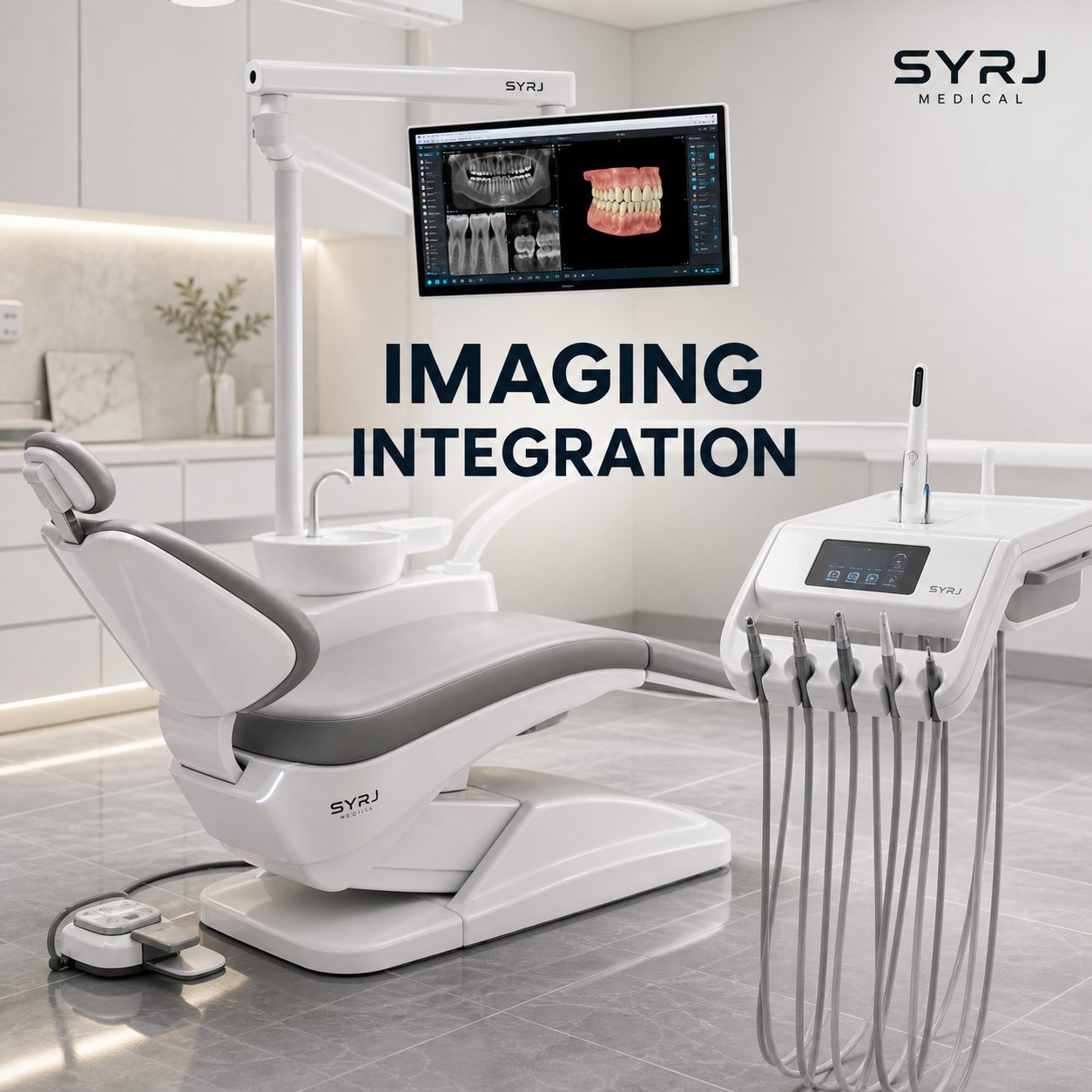
A good implant chair supports review positions, bite checks, hygiene access and restorative work and should be easy to disinfect. With digital impressions, CBCT review or CAD/CAM communication, the room needs a practical display and cable plan. A one stop clinic solution provider can coordinate chair, light, motor, imaging, suction, cabinetry, installation and training.
External video reference: dental implant workflow education. Clinical decisions must be made by qualified professionals.
Hydraulic stability versus electric bases: an engineering decision
The hydraulic-versus-electric base decision should reflect operating conditions. Hydraulic systems may offer smooth, damped movement and stable support, while electric bases may offer programmable positioning and flexible control logic. Neither is universally correct without reviewing case mix, maintenance capability, service network, noise, movement range and spare parts.
For high-precision surgery, stability protects the relationship between the jaw, clinician’s hands, light and instruments. Request a live demonstration with a clinician and assistant, not only a static presentation.
How SYRJ Medical should scope an implant-ready operatory
SYRJ Medical operates as a sourcing and integration partner. The role is to translate the clinical brief into a coordinated equipment scope: implant chair, surgical light, integrated electric implant motor, irrigation, suction, assistant delivery, imaging display, sterilization pathway, room layout, installation coordination and training.
Review the one stop clinic solution, GD-S300 dental chair, GD-S600 hydraulic dental chair and GD-S800 dental chair as planning references. Final suitability must be confirmed against verified configuration, local requirements and clinician protocol.
Why the GD-S600 hydraulic dental chair fits implant-ready operatories
- Stable hydraulic positioning supports a repeatable working geometry during implant assessment and surgery.
- Smooth elevation and controlled movement can help the clinical team maintain patient access while reducing unnecessary repositioning.
- The integrated operatory concept supports coordinated lighting, irrigation, suction, assistant access and digital workflow planning.
- GD-S600 is a planning reference for clinics that value serviceable hydraulic support, ergonomic patient positioning and a coordinated one stop clinic solution.
Note: Final suitability depends on the verified configuration, local requirements and the clinician’s protocol.
Want to see the GD-S600 hydraulic dental chair in operation? Watch the product video below to review its positioning and workflow context.
Video references for implant workflow education
Procurement checklist for oral surgery chairs
| Area | Minimum discussion points | Evidence to request |
|---|---|---|
| Patient support | Stable positioning, head support, access and discharge position. | Demonstration with representative patient positions. |
| Lighting | LED surgical lighting, shadow reduction, intensity and arm stability. | Lighting specifications, controls and service procedure. |
| Motor | Integrated motor, torque control, irrigation and foot control. | Compatibility list, calibration and cleaning instructions. |
| Base | Hydraulic or electric movement, repeatability and serviceability. | Load demonstration, maintenance and spare-part pathway. |
| Digital workflow | CBCT display, intraoral scan review, EMR or CAD/CAM handoff. | Connection diagram and room-layout proposal. |
| Infection control | Smooth surfaces, tubing access, suction and irrigation cleaning. | Manufacturer instructions and consumables list. |
Expert FAQ
What is the most important feature of an implant dental unit?
Reliable integration of stable patient positioning, clear surgical lighting, controlled motor output, irrigation, suction and accessible controls. The unit should support the clinician’s selected protocol while keeping patient, assistant and instruments in a repeatable working relationship.
Why does a hydraulic base matter in minimally invasive implant surgery?
A hydraulic base can provide smooth, damped positioning and a stable platform. Its value should be assessed through movement behaviour, repeatability, serviceability and local support.
What should be included in a dental chair and surgical light configuration?
Plan patient positioning, surgical access, shadow-reduced LED lighting, assistant instrumentation, suction, irrigation, implant motor control, foot operation and cleaning, plus display and cable management for digital records.
Can one implant chair support bone grafting and sinus lift procedures?
A suitable operatory may support these procedures when chair, lighting, delivery system, suction, irrigation, instrument space and room layout are configured for the clinical team. Patient suitability remains a clinical decision.
What should buyers verify when comparing an adec dental chair with another implant-ready configuration?
Compare documented patient access, base stability, movement, light control, motor and handpiece compatibility, irrigation, suction, foot control, disinfection, service response, training and future expansion.
Can clinics buy dental chair online for implant surgery?
Online sourcing can begin the process, but implant equipment should not be selected from photographs alone. Request configuration, installation, compatibility, cleaning, training, warranty and service documentation. Portable dental chair price should likewise be evaluated with transport, utilities, service and intended use.
How should a global clinic evaluate hydraulic stability, digital integration and long-term workflow value?
Evaluate the operatory as a chain of dependent events: base behaviour influences positioning, positioning influences access, access influences posture and visibility, and visibility and motor control influence sequence consistency. Consider service capability, cleaning, spare parts, utilities, training, downtime and future room changes alongside purchase price.
Conclusion
The special requirements of a dental operatory arise from the interaction of CBCT planning, patient assessment, anaesthesia, stable positioning, limited-access preparation, irrigation, aspiration, LED surgical lighting, motor control, stability assessment, loading, healing and follow-up.
A high-quality oral surgery chair is more than a motorised platform. It is a repeatable clinical reference frame. For procurement teams reviewing a dental chair manufacturer in China, documented configuration, quality control, installation and after-sales support matter as much as the product photograph.
Continue Your Implant Surgery Equipment Research
Explore a coordinated dental chair, lighting, imaging and equipment plan.
Explore SolutionsReview GD-S600 for stable patient positioning and workflow planning.
View GD-S600Ready to scale your implant operatory with a coordinated equipment plan?
Click to Get the Latest Dental Treatment Unit Selection Manual and Implant Operatory Quote
Book a Live Video Product Demonstration for Implant Surgery Configurations
Source synthesis and clinical-use note
This equipment guide synthesizes supplied clinical and equipment reference pages. Qualified professionals must determine suitability, technique, loading, medication, anaesthesia and follow-up.
Pediatric Dental Chair and Children Dental Chair: How to Choose a Colorful and Safe Hydraulic Model